Strategic sparring
For companies that need to decide on the direction but have no one who understands subscription logic from the inside.

Clarity. Direction. Growth.
Developing and launching new business models that scale – commercially, organizationally and technologically.
Companies I have worked with and for






A new business model, the introduction of AI, a major ERP or IT program. The concept is usually clear quickly. It gets difficult where the initiative cuts across the organization – across departmental boundaries, responsibilities and established routines.
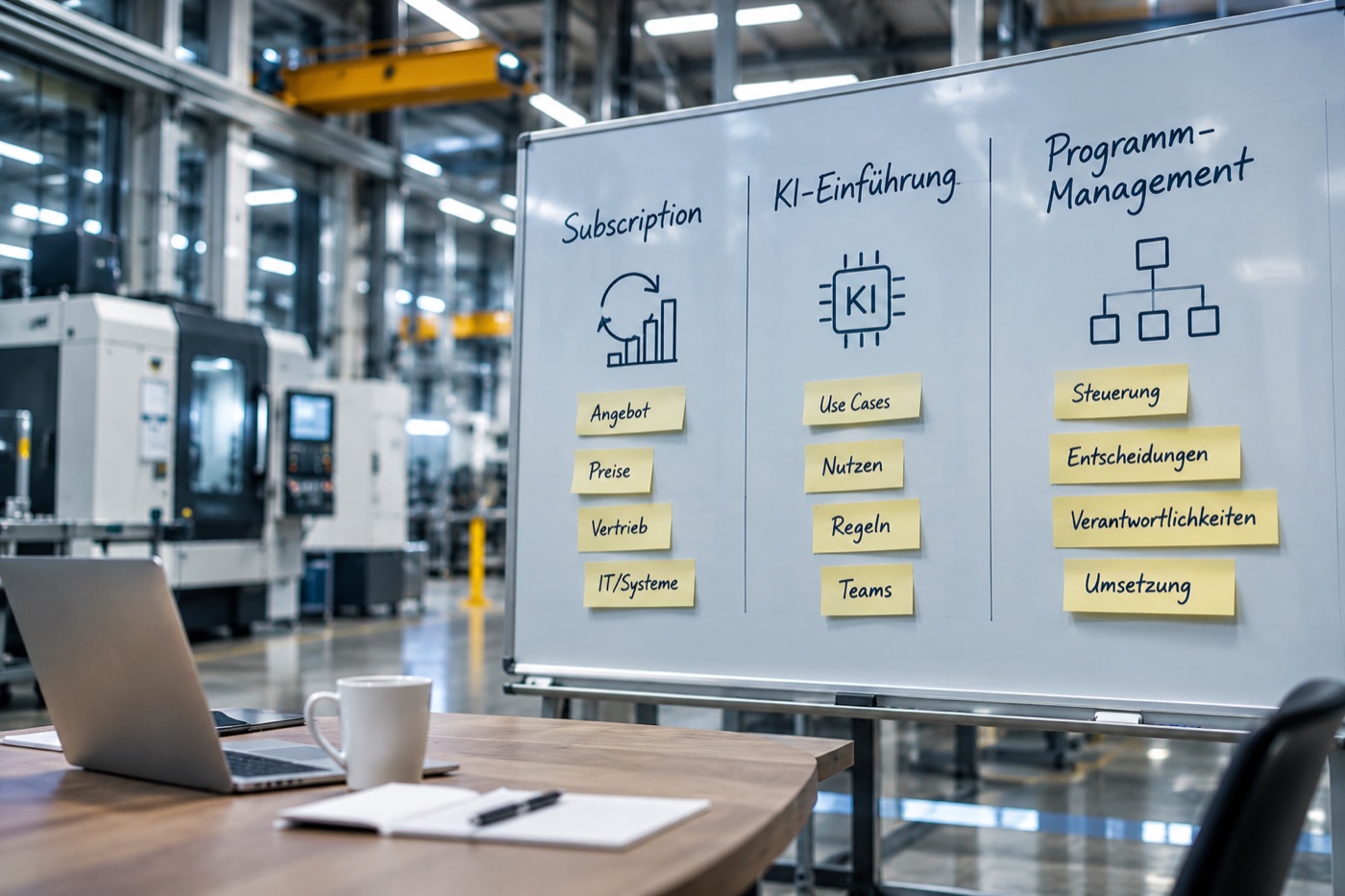
That is exactly where I work. In the subscription business, we build recurring revenue – with the right offering, pricing, sales approach and IT. In AI adoption, we establish where AI genuinely saves time and cost in your processes. We set clear rules for its use and get your teams ready to work with it. As a program manager, I keep complex initiatives on track – with clear governance, timely decisions and responsibilities everyone knows.
Three topics, one pattern. I don’t stop at the concept. I make sure it lands in day-to-day operations.
Not a classic consulting project with sign-off. Instead, guidance along a route I know because I have walked it several times.
Subscription Economy in detail →For companies that need to decide on the direction but have no one who understands subscription logic from the inside.
From the subscriber journey and contract and pricing models through to platform selection and implementation. Not a project with sign-off, but continuous ownership of the line.
A leadership role with targets and accountability – including building the internal team that takes over the role. Because the goal is to make myself redundant.
For companies that don’t want to split strategy and execution across two mandates. I sit at the table with executive management and run the program that implements those decisions – until the MVP is live.
Not sure which station you are at? We can clarify that in half an hour.
Book an initial callAI is on every agenda, but the first steps remain unclear. Either nothing happens – or isolated solutions emerge without a shared goal. In three modules, we take your leadership team from initial orientation to implemented use cases. On site and working on your own case.
AI adoption in detail →Your leadership team develops a shared view of what AI can do for your company – and what it can’t. Shown live rather than with prepared demos, with first use-case ideas from your own business.
Many ideas become three initiatives with a clear implementation path – assessed by impact, effort and feasibility. Plus a jointly developed target picture for your organization.
The prioritized use cases go live while the organization is enabled in parallel – strategy and people change included. It ends with a documented handover. Your IT runs the solutions itself.
30 minutes. Afterwards you’ll know whether this is your path.
Each module can be booked individually. Modules 1 and 2 at a fixed price, plus travel expenses.
ERP migration, IT architecture, process transformation. Many stakeholders, external providers, tight dependencies. Programs like these need a hand that leads – with structure, cadence and a clear line to executive management.
For initiatives that have been decided but don’t yet have a robust structure. Target picture, scope, governance and steering committee – plus a roadmap with a critical path everyone can rely on.
I lead the program through implementation. Workstreams, implementation partners, budget and risks – with a clear cadence through to go-live. Not a project with sign-off, but continuous ownership of the line.
The program ends, the capability remains. I enable your internal program or PMO team and hand over methods, reporting and governance. Because the goal is to make myself redundant.
For companies that want to place a program in one pair of hands from setup to handover – or need to fill a vacant program lead at short notice. I take over leadership with a mandate and accountability, reporting directly to executive management and the steering committee.
Not sure which station your program is at? We can clarify that in half an hour.
Book an initial call
New machine sales fluctuate with every investment slump; the installed base remains. Yet service is usually sold the way it was twenty years ago. On call, by the hour, without a term.
A great deal has been invested in IoT platforms and apps, but hardly any customer pays for them on a recurring basis. Sales is compensated for the machine, not for the contract that follows, and ARR and churn are missing from reporting.
Turning machine, service and software into an offering that customers pay for continuously – and that your organization can sell and deliver.

Hospitals and laboratories are under cost pressure; investments in large equipment are postponed or cancelled. Pay-per-use and device-as-a-service shift costs into the operating budget, but require manufacturers to develop new pricing, contract and financing models.
Consumables, maintenance and software often run in separate contracts and systems. At the same time, regulation such as the MDR ties up the very resources the transformation needs.
A recurring model that pays off for customer and manufacturer alike, holds up under regulation and can be mapped in ERP and CRM.

Fire alarm, access control and video systems are sold through projects. Install, commission, invoice. Often the only recurring element is mandatory maintenance – and that is fiercely contested on price.
Customers are asking for managed services, cloud video and remote monitoring – in other words, contracts rather than installations. From the end of 2027, the Cyber Resilience Act requires security updates for the entire support period – effort that needs to be funded.
Turning installation, maintenance and software into a subscription that grows independently of the project business.
From product business to scalable subscription revenue
International, profitable and scalable – without overstretching the existing organization.
In a short time, the foundation for a marketable subscription model. A clear target picture, end-to-end processes, business requirements, a suitable legal entity structure and a scalable IT architecture for the MVP.
A solid foundation for scaling and internationalization. Details in the initial call.
LeverPragmatic, fast, cross-functional collaboration between management, business units, IT, finance and legal.
Details in the initial call →From a subscription vision to a well-founded provider decision
A shared vision of the future, end-to-end processes and robust requirements – as the basis for selecting a suitable subscription & billing provider.
In around six months. A future-picture workshop, prioritized use cases, an E2E subscription process and enterprise architecture. Requirements gathered in scoping workshops with marketing/sales, finance, SCM and IT, including legal entity structure, after-sales processes and subscription KPIs.
Target picture, use cases, E2E process, enterprise architecture and a consolidated requirements specification. Plus a criteria-based PoC evaluation with a provider recommendation and next steps. Details in the initial call.
LeverDecision by real-world test. Providers prove themselves against real requirements – assessed by criteria agreed in advance.
Details in the initial call →Legacy structures, a complex IT landscape, international requirements. How does a classic machinery business become a viable subscription model that doesn’t overwhelm the organization?
Starting with a Quick Assessment covering 8 focus topics. From there. A clear target picture, end-to-end processes and the selection of a subscription & billing solution – taking into account the legal entity structure developed.
A concrete entry into subscription-based revenue models on a solid basis. Details in the initial call.
Success factorClose, cross-functional collaboration.
Details in the initial call →A program to scale subscription-based solutions combining hardware, software and services worldwide. Program leadership and the core team wanted an experienced counterpart to challenge scope and approach constructively – someone who knows subscription logic from the inside.
Support in two-week sprints. Review of scope and approach with program leadership and the core team. Expert input and feedback on subscription topics raised by the team. Personal sparring for the program lead on structure, planning, risk, priorities and team leadership, as well as governance and the steering committee.
A regular, structured review of scope and approach, subscription expertise exactly where the team needed it, and a sparring partner for governance and committees – with lean effort per sprint. Details in the initial call.
Success factorRecommendations that can be sold internally – including to the CFO and CIO.
Details in the initial call →Make or buy. Putting the in-house IoT platform to the test
The digitalization vision was to be operationalized and consolidated. At its core was a self-developed, Azure-based IoT platform. A proof of concept was to test the hypothesis that standard vendors on the market are fundamentally better. In addition, the requirements for a subscription billing tool were to be captured.
Project organization, a short as-is analysis and interviews with the leadership team, stakeholders and the development team. Leadership of the five workstreams with a focus on process and operational governance. Management of external providers, escalation management and reporting.
Pilot applications from external partners and a decision matrix comparing in-house development and standard product. Hard facts such as requirements, cost and time, plus soft facts such as intellectual property and staffing. Complemented by the subscription billing requirements gathered – handed over to those responsible for operations.
Success factorA clear split of roles between governance and content – and a single point of contact for all internal and external partners.
Details in the initial call →On process, time commitment and investment – and on the concerns that are rarely voiced in a first call.
It starts with a 30-minute initial call. We clarify where your initiative stands and which service fits. Subscription, AI adoption or program management. You then receive a written proposal with scope, duration and a fixed price. You decide in your own time whether and how to start. For the subscription business, there is also a free online Quick Assessment that makes your starting point tangible.
We agree on this before we start. For Module 1 of AI adoption, plan for around four hours on site. Strategic sparring involves fixed sessions with executive management, scheduled around your calendar. In programs, I take care of governance, preparation and follow-up. That way your leadership team spends its time where only it can decide. In the steering committee and on the major course-setting decisions.
Both, with a clear split. Workshops and the AI adoption modules take place on site, because decisions are made faster in the room than on a video call. Ongoing governance, documents and coordination with partners I handle mostly remotely. So we are on site where presence makes a difference. There are no travel days for meetings that work just as well online.
Yes. All formats can be booked individually, with no package obligation. In AI adoption, you decide after each module whether to continue. In the subscription business, you choose the option that matches where you are – for example strategic sparring only. In program management, I can take on just the setup with PMO, for four to eight weeks. Every step delivers a result you can continue working with on your own, even without a follow-up engagement.
The entry formats have fixed prices. The one-day analysis workshop on the subscription business costs €4,900 net plus travel expenses. In AI adoption, Module 1 costs €4,900 and Module 2 €6,900, each net plus travel expenses. The initial call and the online Quick Assessment for your subscription business are free of charge.
Because scope and duration depend on your initiative. A six-week program setup is very different from leading a year-long ERP migration. A price range would say little in either case. So after the initial call you receive a fixed proposal with days per month, duration and price. You then plan with a binding figure for your case rather than an average.
Every format ends with a usable result – not just the overall project. After Module 2 of AI adoption, you have your three most important use cases. Module 3 aims to deliver measurable results in less than six months. In the subscription business, recurring revenue is what counts. Every contract that is renewed rather than resold has an effect for years. We agree at the outset how success will be measured.
Because you need the experience now, but not permanently full-time. A permanent hire for this role means months of recruiting and onboarding – and the risk of a mis-hire. As a Fractional CSO, I work eight to twelve days a month with clear accountability. In parallel, I build the internal team that later takes over the role. The result is your own team, not an extension of my mandate.
I take responsibility for implementation, not just for the concept. As a Senior Program Manager, I lead workstreams, partners and the steering committee myself. As a Fractional CSO, I am accountable for a number. Decisions are made through real-world testing. At Skidata, platform vendors had to meet real requirements in their own environments before a recommendation was made. You get results that run in operations.
Yes, because I don’t work through the program alone – I steer it. I set up structure, workstreams and the steering committee, lead implementation partners and business units, and keep the critical path in view. At the same time, I enable your internal team so the program doesn’t depend on one person. You have one fixed point of contact with the full overview, instead of changing teams who have to get up to speed with every staff change.
No – the opposite is planned from the start. Every mandate ends with a handover. In program management, I embed the PMO in your team over two to three months with decreasing involvement. As a Fractional CSO, I build the team that takes over my role. Methods, reporting and decision documents stay with you. My goal is to make myself redundant, and you can measure my work against that.
My focus is manufacturers. Machinery and plant engineering, medical and laboratory technology, security technology. There, subscription doesn’t emerge from software alone, but from machines, service, spare parts and contracts with a long history. At Eppendorf, I was program manager for an IoT platform PoC, including the requirements for subscription billing. I know the questions sales, service and controlling ask – and the systems where the answers lie.
That is exactly what the collaboration is designed for. I take on the work your team would otherwise have to do on the side. Structure, decision papers, coordination with partners and reporting. Your people contribute their expertise where it is needed, not in every meeting. In AI adoption, we specifically look for use cases that give your teams time back. Relief is not a side effect there, it is the primary goal.
I expect that from the start, because initiatives rarely fail because of the idea – they fail at departmental boundaries. That is why I bring sales, service, finance and IT to the table early and make responsibilities visible. I prepare decisions so that they actually get made in the steering committee. If a program goes off track, I assess the situation soberly and re-plan scope and schedule. That way, resistance becomes visible early and can be resolved.
Because the three topics converge in your company anyway. Subscription changes the business model. AI changes the way people work and turns data into value that customers pay for continuously. Program management ensures that both land in operations across sales, service, finance and IT. With one point of contact who knows all three sides.
International projects at OTTO, six years as CIO at Hermes and many other programs – not presentations. At Eppendorf, I was program manager for an IoT platform PoC with a make-or-buy decision. 80 consulting days in seven months. For Skidata, I steered strategy, design and proof of concept for the subscription process, through to a vendor recommendation. For Schrack Seconet, I analyzed and prioritized AI potential in the finance function. On top of that come my own frameworks such as the Subscription Maturity Model. I am happy to go into the details of each case in the initial call.
Your question isn’t here? We can clear it up in half an hour.
Book an initial callI work with decision-makers when topics get stuck, become hard to oversee or need to be reorganized under time pressure. Digital initiatives, new business models or growth programs where strategy, organization and IT don’t work together cleanly.
My work sits at the interface between business model and execution. Subscription and recurring-revenue strategy on one side, senior program management for complex transformations on the other. I bring structure to complex situations, translate between business and IT, and drive initiatives consistently into implementation. Calm, pragmatic and results-oriented.
For many years I held responsibility in line and leadership roles, and I know how decisions are made under real-world conditions. That is why I don’t work as an outside observer, but as a sparring partner at eye level – preferably with mid-sized companies in Germany, Austria and Switzerland.
“I’m not a classic consultant. I’m a travel companion on a route I know.”Career
If you are at one of these points right now. Write to me. Free of charge and without obligation.